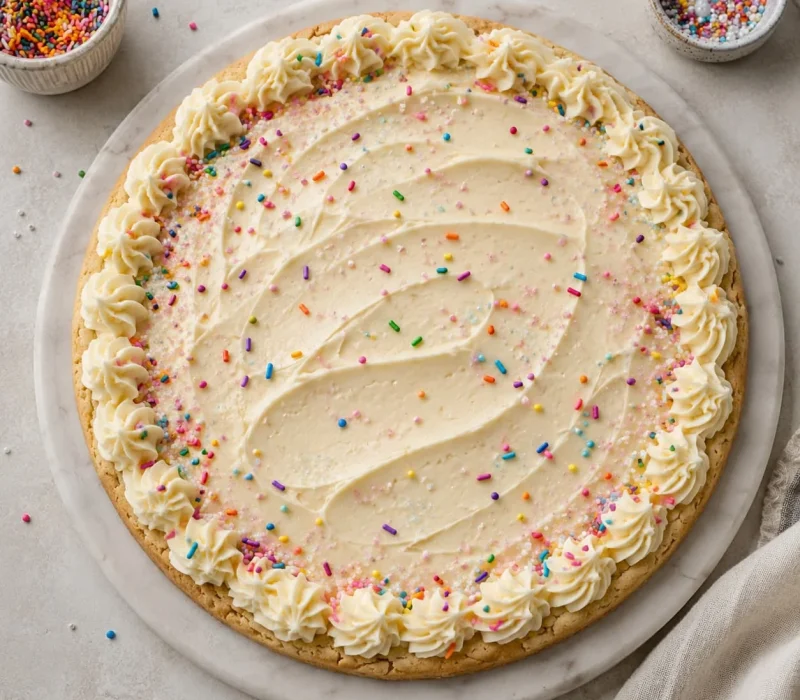
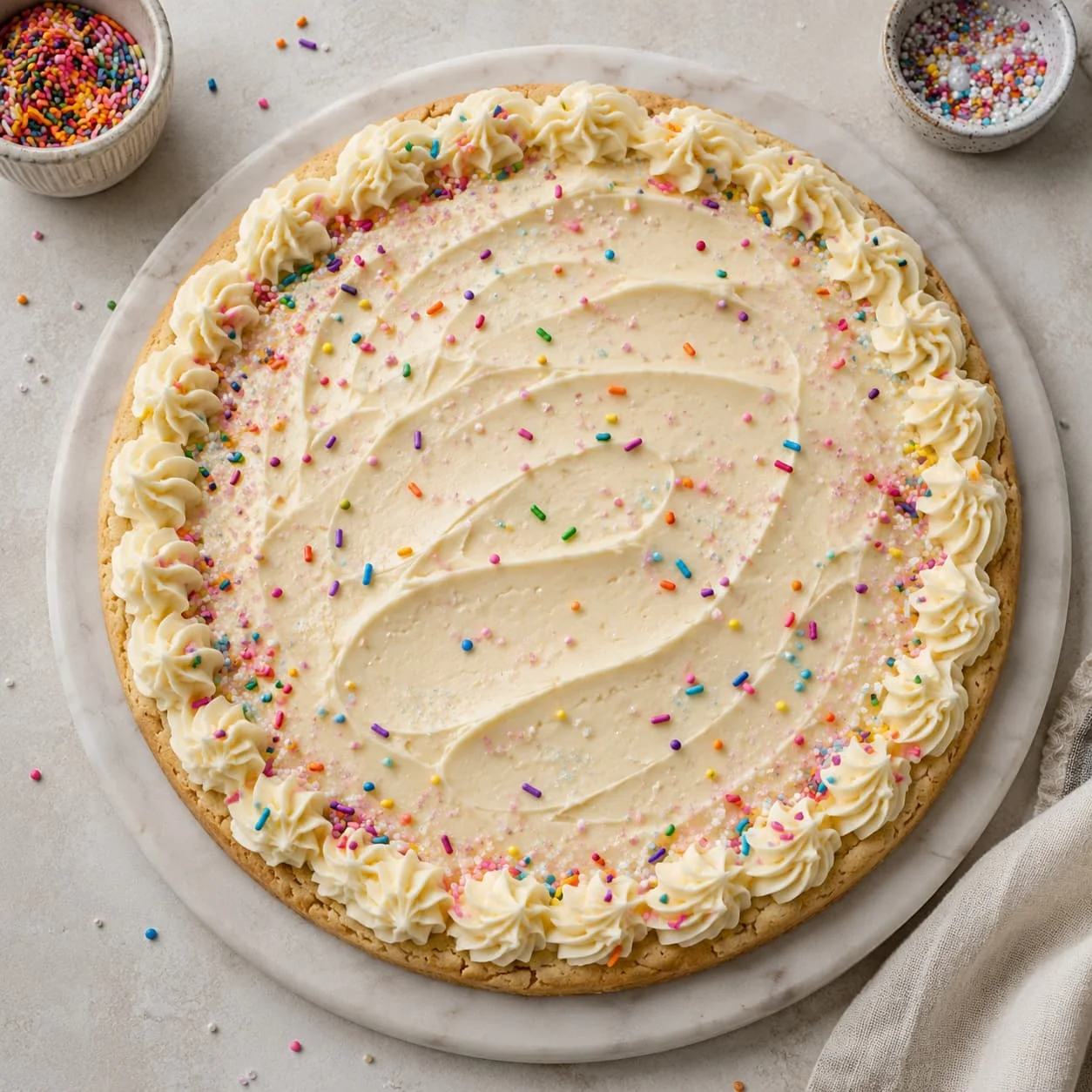
A giant sugar cookie recipe is a single, oversized sugar cookie, usually 8 to 9 inches across, baked as one big round instead of individual cookies, then topped with buttercream frosting and sliced like a small cake.
Key Takeaways
- Baking the dough in a parchment-lined round cake pan, rather than free-forming it on a sheet, is the easiest way to get a perfectly even circle every time.
- Cream of tartar is what gives this cookie its soft, slightly chewy texture; it works by preventing the sugar in the dough from crystallizing as it bakes.
- Because this cookie is so much wider than a standard one, the edges will always set before the center, so look for golden edges and a center that’s just barely set, not fully firm.
- Room-temperature, properly softened butter (not melted) is essential; melted butter is the single biggest cause of a giant cookie spreading too thin.
- Let the cookie cool completely in the pan before frosting, since a warm cookie will melt buttercream on contact.
A giant sugar cookie recipe is one of those desserts that looks like it took real skill and actually just takes one bowl, one pan, and a bit of patience while it bakes. Instead of a dozen small cookies, you get one big, soft, buttery round that slices like a cake and feeds a crowd.
The one thing that trips people up is getting an even shape and even doneness across something this wide. Both are solvable with the right pan and the right way of reading when it’s actually done, which is exactly what this recipe is built around.
What You’ll Need
For the cookie:
- All-purpose flour
- Baking soda and cream of tartar together, these are what make this cookie rise slightly and stay soft instead of turning crisp and hard.
- Salt
- Unsalted butter, room temperature properly softened, not melted; this is the detail that most affects how much the cookie spreads.
- Granulated sugar
- Eggs, room temperature
- Vanilla extract
For the frosting:
- Unsalted butter, softened
- Powdered sugar
- Milk or cream just enough to reach a spreadable consistency.
- Vanilla extract
- Sprinkles or coarse sugar, optional, for decorating
A Little History Behind Sugar Cookies
Sugar cookies trace back to 18th-century Pennsylvania. A sugar cookie’s main ingredients are sugar, flour, butter, eggs, vanilla, and either baking powder or baking soda, and the cookie can be formed by hand, dropped, or rolled and cut into shapes, according to Wikipedia’s entry on the sugar cookie. The giant version is a much more modern spin, essentially treating that same simple dough as a single canvas instead of a batch of small cookies, closer in spirit to a cookie cake than a traditional rolled sugar cookie.
Equipment That Makes This Easier
- A 9-inch round cake pan, which is the real trick to getting an evenly shaped cookie. Pressing dough freehand onto a flat sheet is where most uneven, oddly-shaped giant cookies come from.
- Parchment paper, cut to line the bottom and sides of the pan, so the cookie releases cleanly.
- A hand mixer or stand mixer, for properly creaming the butter and sugar.
- An offset spatula, for spreading the buttercream evenly once the cookie has cooled.
How to Make a Giant Sugar Cookie Recipe
Prep the pan. Preheat your oven to 350°F (175°C). Line a 9-inch round cake pan with parchment paper, cutting it to fit the bottom and come up the sides slightly.
Cream the butter and sugar. Beat the softened butter and granulated sugar together until light and fluffy, about 2 to 3 minutes. This step matters more on a giant cookie than a small one, since it’s the main source of the lift that keeps the center from turning dense.
Add the eggs and vanilla. Beat in the eggs one at a time, then the vanilla, mixing until fully combined.
Mix in the dry ingredients. Whisk together the flour, baking soda, cream of tartar, and salt in a separate bowl. Add to the wet mixture and mix just until no streaks of flour remain; overmixing at this stage can make the cookie tougher.
Press into the pan. Transfer the dough to the prepared pan and press it evenly into an even layer, right into the edges. An even thickness here is what keeps the whole cookie baking at a consistent rate.
Bake. Bake for 22 to 26 minutes, until the edges are golden brown and just pull away from the pan, and the center looks set but not deeply browned. The center will still look slightly soft; that’s correct, it firms up as it cools.
Cool completely. Let the cookie cool in the pan for 15 minutes, then use the parchment to lift it out onto a wire rack to cool the rest of the way. Frosting a warm cookie will melt the buttercream, so don’t rush this step.
Frost and slice. Once fully cool, spread the buttercream evenly over the top with an offset spatula. Add sprinkles or coarse sugar if you like, then slice into wedges to serve.
How Do I Know When the Center Is Actually Done?
This is the most common question with any cookie this size, and it comes down to understanding that a wide cookie simply doesn’t bake evenly from edge to center; the outer ring is closer to the hot pan and oven air, so it sets first.
Instead of waiting for the whole surface to look uniformly done (which usually means the edges have overbaked by the time it happens), look for two specific cues together: edges that are visibly golden and slightly pulling from the pan, and a center that no longer looks wet or shiny, even if it’s still soft to a light touch. Because the cookie continues cooking from residual heat after it comes out, and because it’s baked in a pan (not directly on a sheet), the center reliably finishes setting as it cools, without the edges burning while you wait.
| Problem | Likely Cause | Fix |
| Edges are dark before center looks set | Oven running hot, or cookie pulled too late | Check at the earlier end of the time range; tent edges with foil if they’re browning fast |
| Center sinks slightly after cooling | Slightly underbaked, or cooled too fast | Bake until center no longer looks wet, then cool gradually at room temperature |
| Cookie is dense instead of soft | Butter under-creamed, or dry ingredients overmixed | Cream butter and sugar a full 2-3 minutes; mix in flour just until combined |
| Cookie spread thin and greasy | Butter was melted or too warm | Use properly softened, room-temperature butter, never melted |
| Uneven shape or lopsided cookie | Dough pressed freehand instead of in a pan | Use a round cake pan lined with parchment for a consistent shape |
Is It Safe to Taste the Raw Dough?
A cookie this size means a lot of leftover dough on the spoon and bowl, and it’s worth a quick note here, especially with kids around. Raw flour is milled directly from a raw agricultural grain and can carry bacteria like E. coli, since the milling process doesn’t include a kill step the way baking does, according to the FDA’s guidance on raw flour and dough safety. Raw eggs carry their own separate risk. If you or the kids want to taste-test, keep it to a fully baked cookie rather than the raw dough.
Can You Make This Ahead of Time?
Yes, and it holds up well for planning around a party or gathering.
- The dough: can be made and pressed into the pan up to a day ahead, covered, and refrigerated; bake straight from the fridge, adding a couple of extra minutes to the bake time.
- The baked cookie, unfrosted: keeps well at room temperature, tightly wrapped, for up to 2 days before frosting.
- The frosting: can be made a day ahead and refrigerated; let it soften at room temperature and give it a quick stir before spreading.
How to Store a Giant Sugar Cookie
| Storage Method | How Long | Notes |
| Room temperature, covered | Up to 3 days | Best texture within the first 2 days |
| Refrigerator, covered | Up to 1 week | Let sit at room temperature 20-30 minutes before serving |
| Freezer, unfrosted | Up to 3 months | Wrap tightly; thaw at room temperature before frosting |
| Freezer, frosted slices | Up to 2 months | Freeze individually, then wrap; thaw in the fridge |
More Sweet Treats to Try
If this giant format is fun for you, browse the rest of my cookie recipes or my bars and brownies for more easy, crowd-friendly bakes.
If you love that buttercream topping, my cream cheese pound cake uses a similar tangy frosting if you want to try it on a different base. For something a little richer for the same kind of celebration, my ultimate chocolate layer cake or olive oil cake with brown butter frosting are both great next bakes.
What to Serve It With
This cookie is sweet enough to stand alone with coffee or milk, but a scoop of vanilla ice cream turns a slice into a proper dessert. For gifting or party packaging, a cake box or cookie tin keeps it protected and makes transporting a whole giant cookie much easier.
Frequently Asked Questions
What size pan should I use for a giant sugar cookie?
A 9-inch round cake pan is the easiest way to get an evenly shaped cookie, since pressing the dough freehand on a flat sheet often leads to uneven edges. Lining the pan with parchment also makes it easy to lift the cookie out cleanly once it’s cooled.
Why does the center of my giant cookie stay soft while the edges are done?
This is normal, since a wide cookie’s outer edge is closer to the pan and oven heat and always sets before the center. Look for golden, slightly pulling edges and a center that no longer looks wet, even if it’s still soft to the touch; it finishes setting as it cools.
What does cream of tartar actually do in this recipe?
Cream of tartar helps prevent the sugar in the dough from crystallizing, which is part of what keeps this cookie soft and slightly chewy instead of crisp. It also works with the baking soda to give the cookie a slight rise.
Can I make the dough ahead of time?
Yes. Press the dough into the pan, cover, and refrigerate for up to a day, then bake straight from the fridge, adding a couple of extra minutes to the bake time. This is a good option if you want fresh-baked cookies for a same-day party.
Is it okay to eat raw cookie dough?
It’s not recommended, since raw flour and raw eggs both carry their own food safety risks. If you or the kids want to taste-test, stick to a fully baked cookie rather than the raw dough on the spoon.
Can I make individual cookies instead of one giant one?
Yes, though the bake time will be shorter since smaller portions have less distance for heat to travel to the center. Start checking for doneness around 10 to 12 minutes for standard-sized cookies from this same dough.
Conclusion
A giant sugar cookie looks like a showstopper, but it’s really just a familiar sugar cookie dough baked as one big round instead of a dozen small ones. Once you understand why the edges and center behave differently and use a pan to keep the shape even, it becomes one of the easiest crowd-pleasing desserts you can make.
Giant Sugar Cookie Recipe
Notes
- 1 cup (226g) unsalted butter, room temperature
- 1 1/4 cups (250g) granulated sugar
- 2 large eggs, room temperature
- 2 teaspoons vanilla extract
- 3 cups (375g) all-purpose flour
- 1 teaspoon baking soda
- 1/2 teaspoon cream of tartar
- 1/2 teaspoon salt
- 1/2 cup (113g) unsalted butter, softened
- 2 1/2 cups (300g) powdered sugar
- 1 to 2 tablespoons milk
- 1 teaspoon vanilla extract
- Pinch of salt
- Sprinkles or coarse sugar, optional
- Preheat oven to 350°F (175°C). Line a 9-inch round cake pan with parchment paper.
- Beat butter and sugar until light and fluffy, 2 to 3 minutes.
- Beat in eggs one at a time, then vanilla.
- Whisk flour, baking soda, cream of tartar, and salt in a separate bowl. Add to the wet mixture, mixing just until combined.
- Press dough evenly into the prepared pan.
- Bake 22 to 26 minutes, until edges are golden and center looks set but not deeply browned.
- Cool in the pan 15 minutes, then lift out onto a wire rack to cool completely.
- Beat butter for the frosting until smooth. Gradually add powdered sugar, then milk and vanilla, beating until fluffy.
- Spread frosting over the fully cooled cookie. Add sprinkles if desired, then slice to serve.